
Profile
Alex is a 6-year-old boy diagnosed with Autism Spectrum Disorder (ASD). Individuals with ASD often experience challenges with social interaction, communication, and repetitive behaviors. Alex’s characteristics may present in various ways, including difficulty with social cues, lack of eye contact, and difficulty developing and maintaining relationships with others. Additionally, individuals diagnosed with ASD often experience sensory sensitivities to specific stimuli, which may impact their day-to-day functioning and ability to learn new skills.
When teaching Alex a new skill, the trainer should consider the impact of his disability on learning. It may be essential to provide explicit and clear instructions, along with visual aids, to help Alex understand and process the information. Additionally, training may need to initially be provided in a private and comfortable setting to help him feel at ease. Sensory sensitivities may also need to be considered, with potential adjustments such as reducing the volume of noise, adjusting lighting, or allowing for breaks to facilitate sensory regulation.
Understanding the unique needs and preferences of the individual can play a critical role in facilitating learning and successful skill development. A personalized learning program and patient teaching method will support Alex in succeeding and thriving.
Skills
Alex would like to develop his skills further and learn how to complete age-appropriate tasks around the home, contributing to household chores. The skill Alex would like to focus on is packing away his toys. This new skill will support Alex in continuing to develop his independence in daily routines and take ownership of his belongings.
Strategies
Teaching a child with Autism Spectrum Disorder (ASD) requires a personalized approach that considers individual strengths and interests. Alex would like to learn how to pack away his own toys. To achieve this task, I would utilize four training strategies: (a) Systematic Instruction, (b) A Visual Support, (c) A Social Script, and (d) Assistive Technology. Each strategy will be explained in detail, including effective implementation techniques, key considerations, and research evidence.
Systematic Instruction
Systematic instruction is a teaching method that breaks down complex tasks into smaller, more manageable steps and teaches each step individually. This approach is beneficial for children diagnosed with ASD, who may have difficulty processing and integrating complex information effectively. To teach Alex how to pack his toys away systematically, I would break the task down into the following steps:
- Identify the correct storage containers for the different toy types, such as a box for blocks and a basket for stuffed animals.
- Demonstrate how to place each toy in its appropriate container.
- Provide opportunities for Alex to practice each step individually and scaffold his learning by prompting him with visual and verbal cues, such as showing him a picture of the toy container and saying its name.
Systematic instruction is a highly effective teaching method for children diagnosed with ASD, as it provides clear, structured information that is easily processed by learners (Alzrayer et al., 2019).
Visual Support
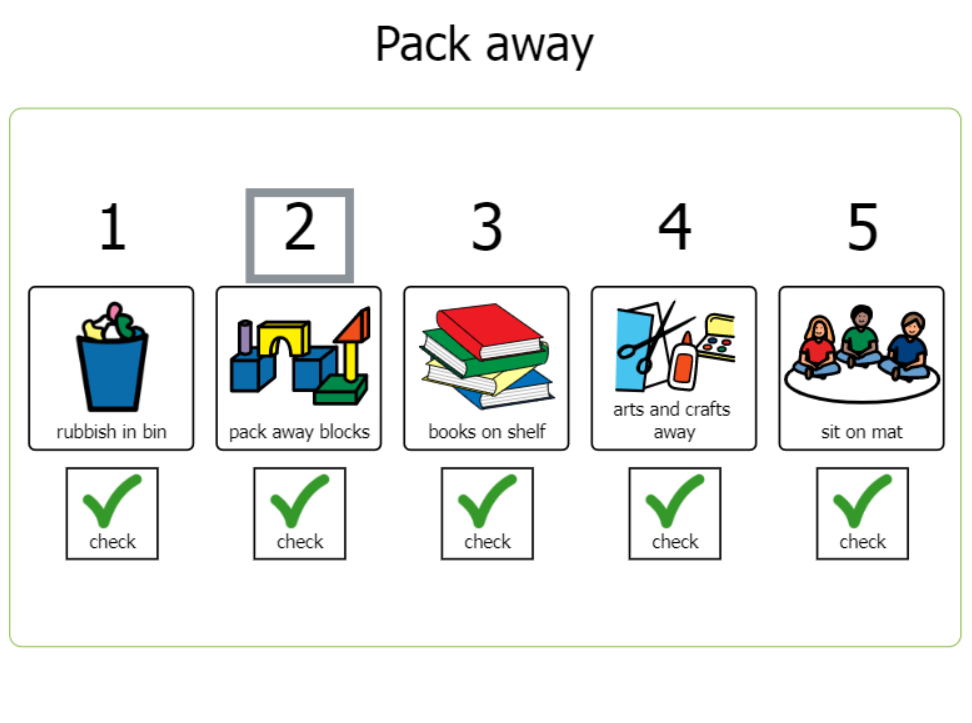
A visual support is a tool that uses images, symbols, or pictures to help individuals diagnosed with ASD better understand information. Visual supports can be used to support comprehension, reduce anxiety, and improve communication. To teach Alex how to pack his toys away with the support of a visual schedule, I would create a picture-based chart that illustrates each step in the process of packing away the toys. The visual schedule would be displayed in a prominent location, such as above the toy storage containers. Providing a visual support has been shown to increase understanding and decrease anxiety for children diagnosed with ASD, as it helps them process abstract information more effectively (Hu et al., 2021).
Social Script
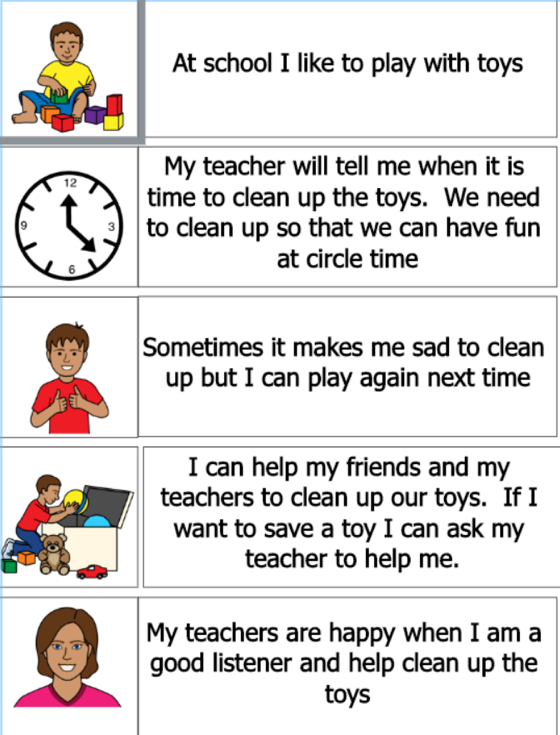
A social script is a written or pictorial description of a social situation or interaction. It can be used with children with ASD to help them understand how to behave appropriately in social situations. To help Alex learn to put his toys away using a social script, I would develop a script that outlines the steps of playing with his toys. This would include setting up play, playing, and then packing away toys, all in simple steps, accompanied by clear visual cues. The script would be read to Alex the social process of play and packing away, and repeated several times to familiarize him with the process. Social scripts can be effective in reducing anxiety, increasing motivation, and improving social interactions for children diagnosed with ASD (Coogle et al., 2018).
Assistive Technology
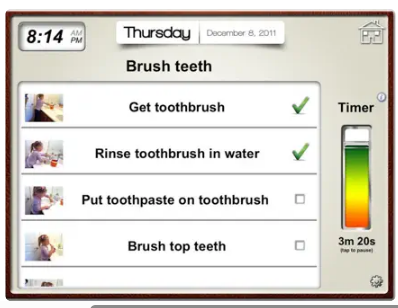
Assistive technology can be used to help individuals with ASD communicate and interact more effectively with the environment and others. To teach Alex how to pack his toys away using assistive technology, I would provide him with a device that uses visual or auditory prompts to guide him through the process. The device could be a simple app on a tablet or smartphone that provides a step-by-step guide with pictures and a timer function for reminders to complete the task. Assistive technology is efficacious in improving social interactions, communication, and behavioral difficulties in children with ASD (Syriopoulou-Delli & Gkiolnta, 2020). The above strategies would be personalized to Alex’s current comprehension and skill level, and adapted over time as further skills develop.
Artifacts
Systematic Instruction
- Skill: Packing away toys
- Learner: Alex, 6 years
- Trainer: …
Visual Support
Social Script
Assistive Technology

Comprehensive Program
To ensure Alex successfully packs away his toys across various environments and times, the trainer would follow a structured approach that incorporates the concepts of maintenance, generalization, and fading. Maintenance refers to the ability to maintain a skill over time, while generalization involves applying a learned skill to different settings and situations (Tiger et al., 2008). Lastly, fading involves gradually reducing the level of support provided to the learner to enhance independent functioning.
Firstly, the trainer would use systematic instruction to teach Alex how to pack away his toys step by step (Alzrayer et al., 2019). Once Alex has mastered the skill within a controlled environment, the trainer would gradually introduce variations to encourage generalization. For example, they could have Alex pack away toys in different rooms of the house or outside in the garden.
To promote maintenance, the trainer would implement a plan to review and reinforce Alex’s skills regularly. This could involve setting up a reward system, where Alex earns stickers or tokens for completing the task correctly. The trainer would gradually increase the time between reinforcements to encourage Alex to complete the task independently. Additionally, the trainer may involve parents or caregivers in the reinforcement plan to ensure consistency across different environments.
Finally, to encourage fading, the trainer would gradually reduce the level of support provided to Alex. This could involve reducing the number of verbal prompts or providing fewer visual cues. The trainer would then observe Alex’s performance to determine if he can complete the task independently. If not, the trainer would continue to provide minimal support until Alex achieves mastery.
References
Alzrayer, N. M., Banda, D. R., & Koul, R. K. (2019). The effects of systematic instruction in teaching multistep social-communication skills to children with Autism Spectrum Disorder using an iPad. Developmental Neurorehabilitation, 22(6), 415–429.
Coogle, C. G., Ahmed, S., Aljaffal, M. A., Alsheef, M. Y., & Hamdi, H. A. (2018). Social narrative strategies to support children with Autism Spectrum Disorder. Early Childhood Education Journal, 46(4), 445–450.
Hu, X., Wang, H., Han, Z. R., Zhao, Y., & Ke, L. (2021). The influence of visual supports and motivation on motor performance of the MABC-2 for Chinese school-aged children with autism spectrum disorder. Scientific Reports, 11(1).
Syriopoulou-Delli, C. K., & Gkiolnta, E. (2020). Review of assistive technology in the training of children with autism spectrum disorders. International Journal of Developmental Disabilities, 68(2), 73–85.
Tiger, J. H., Hanley, G. P., & Bruzek, J. (2008). Functional communication training: A review and practical guide. Behavior Analysis in Practice, 1(1), 16–23.