
Introduction
Aspects of a nation’s socioeconomic status include education, income, financial stability, careers, living standards, and opportunities available to citizens. The government’s monetary and fiscal policies significantly affect the status, which in turn affects employment, income distribution, and access to essential services. These policies include employment, progressive taxation, and redistribution of resources to address inequality and enhance social welfare. Politics plays a crucial role as a system of formal institutions and guiding principles that specify how people align with ideologies and power.
Homework Workload for Elementary Learners in China
Professionals and parents are concerned about the Chinese education system because of its reputation for excessive stress, burnout, and depression. According to Wu, Chinese elementary students spend an average of 2.82 hours a day on homework, more than double the global average (par. 4). Experts and parents have since called for fairer homework assignments and an education system that goes beyond exams. The Ministry of Education reacted to the concerns by establishing guidelines for student homework (Ming and Jing 49). The sufficiency of academic hours to cover all learning material, reasonable school timetables, and out-of-school assignments should accommodate learners’ health and social needs.
Primary Education in China
In China, elementary schooling begins when a child is 6 or 7 years old. Two subjects, arithmetic and Chinese, comprise the primary content of the curriculum. Other topics covered in schools include practical work, morals, society, nature, music, and art. Some schools introduce extracurricular activities and begin teaching foreign languages around the end of primary school.
The academic year spans nine months, starting in September and ending in January or February for winter breaks and July and August for summer vacations. Except for large cities like Beijing or Shanghai, where a six-year system is more typical, primary education in China typically lasts five years (Wu). Following primary schooling, children are required to take exams to assess their proficiency in math and Chinese.
Homework Overload Concerns
For Chinese students, homework has become a major burden, leading to excessive schoolwork and sleep deprivation. Students spend twice as much time on schoolwork daily as the global average of 2 hours, and sleep fewer than 7 hours (Wu). Sleep deprivation, for instance, has affected some learners’ physical and mental well-being. The root issue is examination-oriented schooling, which prioritizes passing high school and college entrance tests over providing students with a quality education (Zhang 821). Another factor is teachers who do not understand their jobs well and focus too much on their personal interests and exam scores.
Pupils who have too much homework may experience psychological distress, and some may turn to dishonesty, absenteeism, plagiarism, and other forms of avoidance to get by. Reverse psychology can occur when students start complaining about their instructors and classes. This can reduce their psychological interest in learning and their overall motivation to study (Zhang 822). Additionally, excessive assignments can leave kids feeling bored, powerless, and sleepy, which can negatively affect their learning and overall health.
Causes of Overload
Despite being centralized, China’s elementary and secondary schools do not communicate well when assigning homework. Teachers frequently assign more schoolwork than pupils can handle, creating a coercive and irresponsible system (Zhang 822). Some scholars have recommended that educators communicate to manage homework and prioritize quality over quantity, thereby reducing the amount assigned.
With so many teaching responsibilities and limited time, many educators are reluctant to investigate new types of homework and individualization issues. Homework must be “the finest, the better,” emphasizing ideas relevant to the students(Zhang 823). The author noted that teachers do not provide tailored homework to students’ or families’ schedules (Zhang823).
The individualized homework plans do not take into account each student’s unique needs regarding mental and physical development. Additionally, many educators disregard the adverse effects of off-school assignments on students in favor of academic success (Ming and Jing 81; Zhang 823). Generally, teachers may not recognize or take the issue seriously due to this lack of knowledge and comprehension, which could leave them with little regard for the nation’s future and the children.
Mitigations Adopted by China
China’s “Double Reduction” program promotes a happy childhood and relieves pupils of overburdened learning tasks. It was implemented in 2021 and requires schools to improve after-school programs, enhance student experiences, and concentrate on developing age-appropriate language, math, and artistic skills while fostering five merits (Ming and Jing 72). Reducing students’ workloads in K–12 education is the primary goal of implementing the all-around education philosophy at all levels of learning. The strategy seeks to lower excessive study loads, safeguard students’ health, ease parents’ concerns, lessen social inequality, and raise educational standards. Other measures included reducing testing and homework, expanding non-curriculum training sectors, extending after-school services, and increasing public school teachers’ pay.
Homework Load in the U.S.
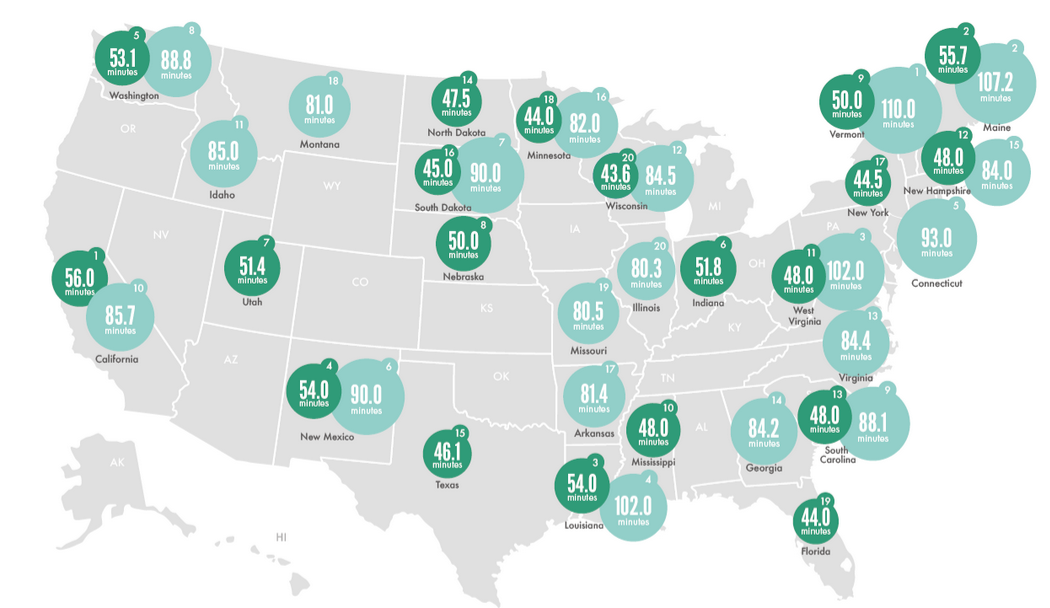
The average daily assignment for elementary school students in the United States is less than an hour (Fig. 1). A 10-minute homework limit per grade level is supported by the National Education Association and the National PTA. However, concerns about stress and limited free time still affect children’s ability to manage the revised hours (Wood). While acknowledging the value of homework for character development and academic performance, a growing trend advocates greater student autonomy.
Parents contend that rather than finishing projects, after-school time should be spent playing outside or with family (Wood). By grade level, the “10-minute rule” suggests assigning 10 minutes of homework each night (Wood). However, according to a 2015 study, elementary school students were given three times as much homework as was advised, which put more strain on families (Wood). Excessive amounts of homework persist in the U.S., particularly long projects, which can burden families and negatively affect kids’ attitudes toward school.
In the U.S., kindergarten classes typically last three to four hours, while some institutions offer full-day classes lasting six to eight hours. The length of the school day is designed to provide young students with a favorable educational experience by balancing learning, play, and relaxation (Wood). Students spend more hours in school as they advance from first to fifth grade. On average, students spend six to seven hours a day in most elementary schools, taking math, science, language arts, social studies, physical education, and art and music courses. However, the precise hours may vary depending on the educational philosophy, scheduling requirements, local laws, and the school system.
How U.S. Workload Compares to China
In China, students must devote significant time outside of class to studying and completing homework assignments, which is critical for expanding their knowledge and preparing for tests. Americans spend an average of less than an hour completing homework, whereas the Chinese spend 2.82 hours. It demonstrates that elementary kids in China spend nearly three times as many hours on homework as students in the United States. However, the school hours in both countries are comparable, with most children attending lessons between 8:00 AM and 4:00 PM. Parents in both states believe the existing set hours for assignments are excessive, meaning that more than two hours in China is considered extreme.
Overwhelming homework schedules have a detrimental effect on kids’ mental and physical health worldwide by raising anxiety levels. For example, students in China’s education system experienced higher stress levels, leading to the implementation of the “Double Reduction” policy, comparable to policies in other states, such as the United States (Ming and Jing 72). Despite the extended hours spent on assignments, studies reveal that completing more homework did not translate into better exam results (Molen). For the past century, there has been discussion on the pros and cons of assigning homework to elementary school students.
Findings from both countries indicate homework can have a detrimental effect on emotional and physical health, especially among young people from low-income families. According to research, children who have too much homework are more likely to experience physical health issues, high levels of stress, and a lack of balance in their lives (Ming and Jing 79; Molen). Additionally, there is increasing agreement that children reared in wealth may also be more susceptible to mental health issues(Ming and Jing 71). Schools must consider the objectives they aim to achieve when assigning excessive homework. They ought to provide an equal and reasonable quantity of work as well.
Learning About Educational Practices in China
As a prospective teacher in Southern California, I believe there are many insights to be gained from methods in China. As the world changes, some tactics might not work as well as they once did. China, for example, has gained knowledge from its rigorous, competitive strategy that emphasizes students. One effective model for kids in the current generation is the “Double Reduction” policy.
China’s approach to elementary education strongly emphasizes having fun while learning, enabling pupils to have happy and meaningful childhoods. The “Double Reduction” strategy aims to reduce excessive study loads, safeguard students’ health, ease parents’ concerns, reduce social inequality, and regulate off-campus training. The most common issues with mandatory education, such as the overwhelming amount of homework assigned to elementary and middle school pupils and the strain that off-campus tutoring places on parents, will be addressed by this legislation.
Regulations prioritizing sleep over homework are recommended, given that China’s education system faces criticism for its heavy workload. The new policy, however, has not addressed the exam-focused structure of the education system, which has led Chinese kids to forgo social development in favor of college entrance exams. Reducing homework and school hours through policy requires addressing the underlying causes of the excessive academic burden.
Children benefit from homework because it supplements what they learn in class, helps them develop independent study skills, and facilitates communication between parents and schools. On the other hand, many who oppose homework contend that it can lead to health problems and undue stress in kids (Ming and Jing 72). Throughout the first part of the 20th century, people’s opposition to homework stemmed from their desire for more engaging and creative activities (Molen). Parents who set high standards for their kids demand that their kids complete extra homework to prepare them for elite universities.
Affluent communities are the ones where this tendency is most noticeable, contrary to expectations. Guidelines such as “The 10-Minute Rule” indicate that kids should do 10 minutes of homework per night, based on their grade level. The relationship between achievement and homework often supports these recommendations. The relationship is good until kids finish one to two hours of homework every night in middle school. As a mother, Garfield has clear guidelines for her children’s homework, encouraging one subject per night so they can completely live and enjoy their childhood.
There is a correlation between poorer teachers and less efficient educational systems and the rise of “shotgun homework” assigned in elementary and middle schools. The foundation of a good homework assignment is the effort and feelings it evokes. Nightly reading requirements have replaced homework in many elementary schools. This has increased vocabulary, fostered creativity, increased concentration, memory, empathy, and reduced stress.
A fair amount of homework depends on the learner’s grade and should not be extensive. Molen noted that a reasonable quantity of homework should be completed every night for two to two and a half hours, with 90 minutes to two and a half hours being ideal for high school students based on Stanford Research (par. 11). Teachers are providing office hours to assist students with assignment questions, time management, and assignment prioritization. Excessive homework, particularly long projects, can negatively affect students’ attitudes toward learning and their ability to sustain attention for short periods.
Works Cited
Ming, Kong, and Chen Jing “Chapter 2: Elementary Education in China.” Education in China and the World: Achievements and Contemporary Issues, edited by Wang Qi, Shangai Jiao Tong University Press, 2024, pp. 47–88.
Molen, Keira “Ease Homework Overload to Improve Student Mental Health” The Pearl Post, 2022.
Wood, Sarah “Should Kids Get Homework?” U.S. News, 2022.
Wu, Andy “Heavy Homework Burden Deprives Chinese Children and Parents of Their Leisure.” The Public Ear, 2019.
Zhang, Jianjun “Homework: An Overload on Chinese School Children.” International Journal of English Literature and Social Sciences, vol. 4, no. 3, 2019, pp. 821–24.